
Literacy Curriculum
At Queenscliff Primary School, our Literacy program aligns seamlessly with the Victorian Curriculum F-10 and provides fundamental skills, strategies and attitudes towards learning. We aim to foster a lifelong love of reading in our students, as well as confidence in their writing and effective interpersonal and communication skills. We believe all students can achieve success in Literacy and transfer these skills into their daily life to be active and informed citizens in our community.
Instructional Model
Queenscliff Primary School practises a consistent approach to all literacy programs using our Literacy Instructional Models for Prep to Year 2 and Year 3 to 6. At QPS, our weekly literacy program incorporates the seven fundamental components of literacy, including:
- Phonemic Awareness - the ability to hear and manipulate individual sounds in words
- Phonics - the understanding that letters represent the speech sounds of our language
- Vocabulary – the knowledge of words and their meanings in context that we must know to communicate effectively
- Fluency - the ability to read text accurately, quickly and with appropriate expression
- Comprehension – the ability to make meaning from texts through literal, inferential and critical understanding
- Grammar – the ability to understand the constructs of the English language, including morphology, syntax and punctuation
- Oral Language – the ability to use words and sounds to communicate meaning
Our Instructional Models for Prep to Year 2 and Year 3 to 6 vary. This is due to a greater focus on phonics, phonemic awareness, oral language and fluency in the younger years and a greater emphasis on morphology, comprehension, grammar and writing skills in Year 3 to 6. Students in Year 3 to 6 engage in termly novel studies whereby students are exposed to a range of diverse, rich texts including persuasive, narrative, informative and hybrid texts. Throughout the novel study, students not only expand their vocabulary and understanding of comprehension skills, but learn key concepts and principles of grammar and syntax that are essential for writing development.
English Instructional Models
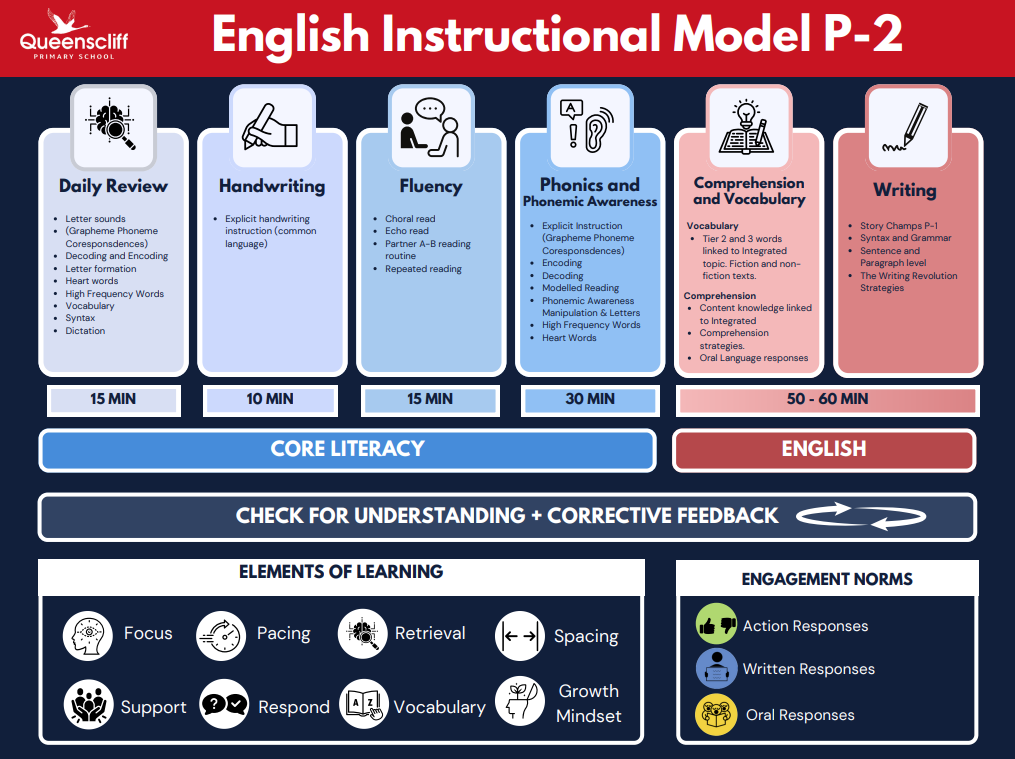
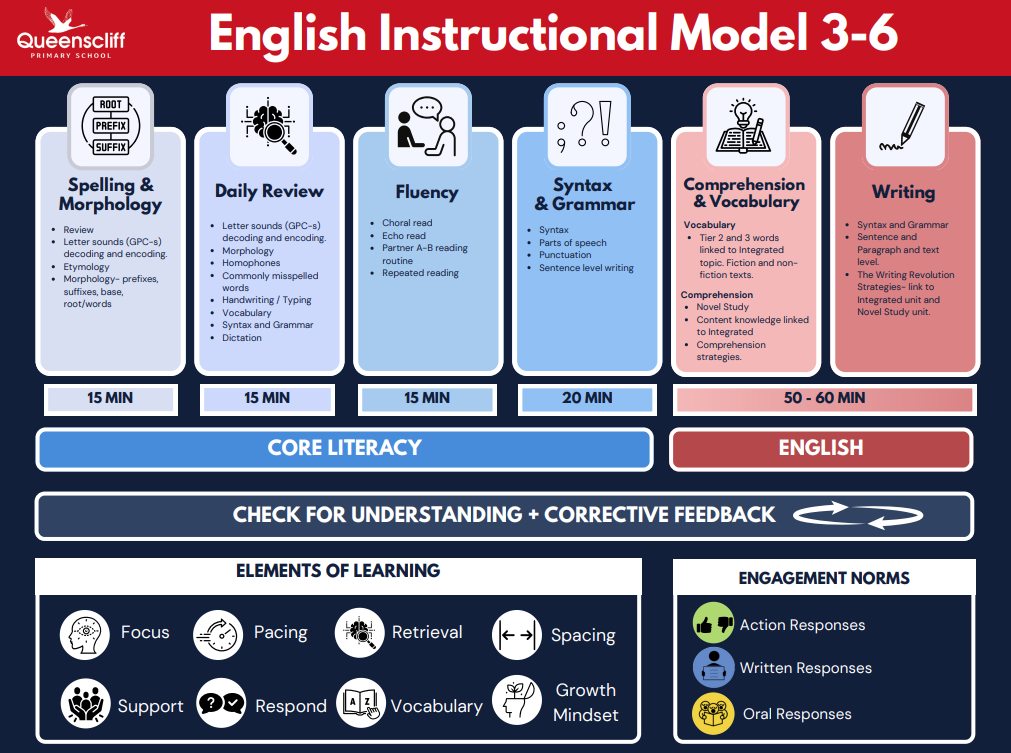
Spelling
In the early years, we teach our students to read, spell and write using fun, engaging and evidence-based practises. We teach with a structured, systematic and explicit literacy program with engaging multisensory activities to foster students’ understanding, skills and knowledge of literacy.
Our literacy programs are carefully sequenced in seven stages to teach children the 44 sounds of the English language and the principles of the alphabetic code (that each speech sound can be represented by different groups of letters, such as the sound /ī/ as in I, sky, pie, ice, cycle, and that a letter(or group of letters) can represent different sounds, such as the letter ‘y’ in yes, gym, funny, sky. We start with teaching the simple code in Stages 1–4. We focus on phonics and phonemic awareness to build the strongest foundations for reading and spelling success.
Across all year levels we follow a structured literacy approach. Children learn at a quicker rate if they are taught systematically and explicitly using synthetic phonics and a structured literacy approach. They know what they are learning and can verbalise it.
Our Literacy Instructional Model incorporates explicit teaching, shared construction and individual exploration, reflective of a gradual release framework. Our teachers follow an “I do, we do, you do” structure during Literacy instruction.
- I do - teacher instructs and provides a model for literacy instruction
- We do - guided practice supported by the teacher in understanding and mastering the literacy concept
- You do - the learner practises/applies new content independently – moving towards mastery.
We focus on building knowledge, speaking, and listening and vocabulary skills to develop equally strong foundations in literacy. Students will develop these skills by being exposed to language rich units, non-fiction texts and authentic texts.
Spelling Mastery
Students in Years 3 to 6 at Queenscliff Primary School engage in daily spelling activities through the implementation of the Spelling Mastery program. Spelling Mastery builds dependable spelling skills for students through a highly structured direct instruction method that blends the following approaches:
- Phonemic approach - helps beginning spellers learn the relationships between spoken sounds and written letters and then apply them to spelling
- Morphemic approach - exposes advanced spellers to prefixes, bases, and suffixes
- Whole-word approach - gives spellers at all levels the meaning and root of a word and shows how the word's spelling is influenced.
Spelling Mastery interweaves these three approaches according to students' skill development. Explicit instruction, careful selection of spelling words, and repeated and cumulative practice will helps our students master each concept and reinforce and retain key information. The program uses an explicit, teacher-directed method of teaching called 'Direct Instruction'. Spelling Mastery is an effective, research-proven spelling program that teaches students the strategies they need to become successful, life-long spellers. The Spelling Mastery program is differentiated and students are grouped to work with different teachers throughout the week to ensure that their spelling instruction is delivered at their point of need.
Queenscliff Primary School's Approach to Teaching Reading
At Queenscliff Primary School, our reading instruction is grounded in the Science of Reading and informed by the Victorian Teaching and Learning Model. We believe every student can become a successful reader through explicit, systematic and evidence-informed instruction.
Our reading program develops all essential components of skilled reading, including oral language, phonological awareness, phonics, vocabulary, reading fluency and reading comprehension. Lessons follow an explicit teaching model, with teachers modelling new learning, providing guided practice and gradually releasing responsibility so students can apply their learning independently.
Students participate in a range of structured reading experiences throughout the week, including:
Teachers explicitly teach and model decoding, vocabulary, language structures, fluency and comprehension strategies. Students learn how skilled readers think before, during and after reading while building background knowledge and understanding of increasingly complex texts.
Teachers and students read texts together, providing opportunities for explicit instruction and guided practice. Students apply decoding skills, build vocabulary, develop language comprehension and engage in rich discussion about the meaning of texts.
Students listen to a fluent model before reading the same section aloud. This evidence-based practice strengthens reading accuracy, automaticity, phrasing, expression and confidence.
Students read together with the teacher or peers to develop fluency, prosody and reading confidence while receiving immediate support and feedback.
Students read appropriately selected texts with a partner to consolidate decoding and fluency skills while developing oral language, comprehension and confidence through discussion and feedback.
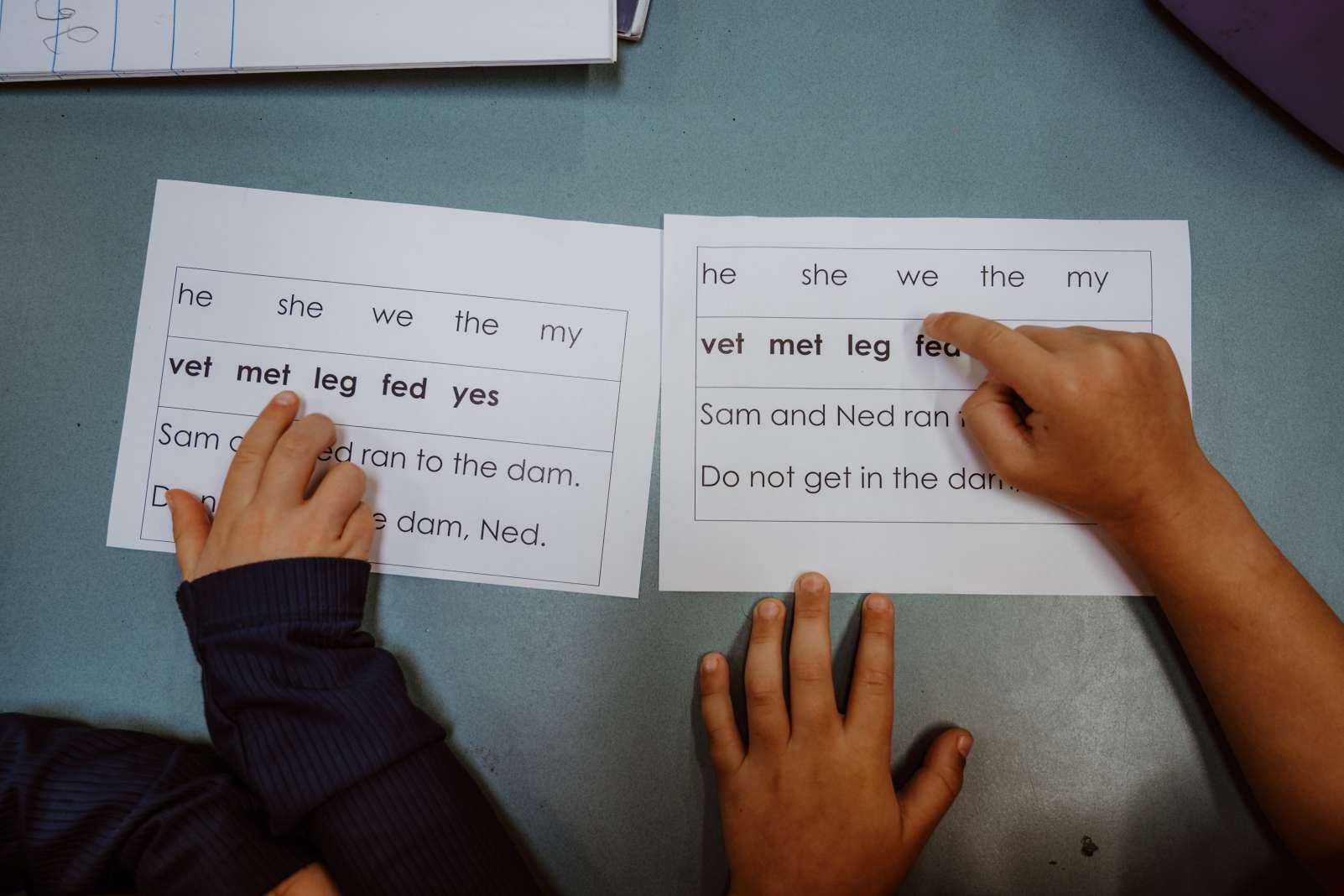
Rich Texts (Prep–Year 2)
In Prep to Year 2, students engage with carefully selected, high-quality authentic texts. These rich picture books and informational texts are chosen to build students' vocabulary, oral language, background knowledge and comprehension.
Teachers explicitly teach the structure and features of both narrative and informative texts, helping students understand how different texts are organised and how authors communicate meaning. Through discussion and purposeful response activities, students develop comprehension, make connections, build knowledge and strengthen their speaking and writing skills.
The texts have been selected to expose students to diverse authors, cultures and perspectives, including First Nations histories and cultures. Where appropriate, the texts also connect with integrated curriculum units and explore themes of our local coastal environment, ocean and waterway sustainability, and caring for Country and Place, helping students develop a deeper understanding of the unique environment in which they live.
Novel Studies (Years 3–6)
Each term, students in Years 3 to 6 engage in reading a novel. Novel studies build language comprehension, vocabulary and knowledge through engagement with rich, high-quality literature. Teachers explicitly teach and interweave comprehension strategies while responding to the text. Students participate in structured discussions and respond to texts through speaking and writing.
Our novels are carefully selected to:
- build students' background knowledge and cultural understanding
- include First Nations histories, cultures and perspectives
- expose students to a diverse range of authors, genres and text structures
- develop sophisticated vocabulary and language comprehension
- connect with integrated curriculum topics where appropriate
- explore themes that reflect our local environment, including ocean and waterway sustainability.
Writing
Our students learn to write authentic, rich texts intended to be read by others, and are guided through the writing process through explicit teaching and worked examples. Students learn to identify and use the different features from various genres, such as narrative, informative and persuasive texts. Through our comprehensive writing programs, our students learn to understand the organisation and structure of texts, language features, the author’s purpose and voice, sentence structure and the conventions of writing, including grammar and punctuation. Our teachers apply our Literacy Instruction Model with the Writing Cycle, of Modelled Writing, Joint Construction, and Independent Writing, to deliver comprehensive and differentiated writing programs. Our students are nurtured to become confident and capable writers. Writing programs are unit based and genre-focused relating to the Integrated Studies topic or relevant school-based experiences that follow the guidelines of the writing process of plan, draft, revise, edit and publish.
At our school, we are committed to developing strong, confident communicators. Through the integration of The Writing Revolution (TWR) practices across all year levels and subject areas, we explicitly teach students how to structure their thinking and express their ideas clearly and effectively. By embedding sentence-level strategies, paragraph development, and planning techniques into everyday learning, we support students to deepen their understanding of content while building essential writing skills. These evidence-based practices empower our students to become thoughtful writers and critical thinkers, preparing them for success in all areas of their education.


Handwriting
Handwriting is explicitly taught within our literacy programs between 30 to 45 minutes per week. Our teachers model correct letter formation using the Victorian Handwriting Style and students begin to learn cursive writing in Year 3.
Assessment
Teachers use ongoing, evidence-based assessment to identify students’ strengths, monitor progress and provide targeted teaching and support. Assessment data is used to identify individual learning needs and ensure every student receives the instruction required to become a successful reader.
Our goal is to develop confident readers who decode accurately, read fluently, comprehend deeply and develop the literacy skills and knowledge needed to thrive in the future.
Literary Festival
Our students are provided with the unique opportunity to participate in the Literary Festival in the Borough annually. Students celebrate literacy by attending workshops with published authors and are provided with learning experiences to further develop their skills and confidence as capable writers.
All students are fostered to pursue their literacy skills with a growth mindset, developing resilience and responsibility in their approach to learning.